

Espresso is the most demanding brewing method when it comes to grind consistency and adjustability. A change of just a few microns in particle size can turn a balanced shot into a gusher or a choked drip. This article explains why espresso grinders require fine adjustment, what stepless versus stepped settings mean, how single dosing and grind retention affect your workflow, and how to choose a grinder that fits your home setup.
Why Espresso Needs a Grinder That Can Make Small Changes
Unlike pour-over or drip coffee, espresso relies on pressure. Water is forced through a compacted puck of coffee at around 9 bars of pressure. The resistance of that puck depends directly on how finely and uniformly the coffee is ground. If the grind is too coarse, water flows too fast and the shot is sour and thin. If the grind is too fine, water barely passes and the shot is bitter and slow.
Getting the grind exactly right is only half the challenge. Coffee beans change from day to day as they age, and humidity, temperature, and bean origin can shift the ideal grind setting. A grinder for espresso needs to let you dial in with precision and then make small, repeatable adjustments as conditions change. That is why the adjustment mechanism is one of the most important features of any espresso grinder.
Stepless Versus Stepped Adjustment
The adjustment mechanism on a grinder determines how finely you can change the distance between the burrs. There are two main designs: stepped and stepless.
Stepped Adjustment
A stepped grinder uses a ratcheting mechanism that clicks into discrete positions. Each step changes the grind size by a fixed increment. This is common on entry-level espresso grinders and on many grinders designed primarily for filter coffee.
The advantage of stepped adjustment is that it is easy to understand and repeatable. You can return to the same numbered setting reliably. For a home barista pulling a single type of coffee at a consistent dose, a stepped grinder with fine enough steps can work well.
The downside is that the step size may be too large for espresso. If one step turns a good shot into an over-extracted one and the previous step leaves it under-extracted, you are stuck. Some grinders address this by offering micro-steps, but in general, the smaller the step size, the better for espresso.
Stepless Adjustment
A stepless grinder uses a continuous adjustment mechanism, often a threaded ring or a lever with friction, that lets you set the burr gap to any point between the extremes. There are no clicks or stops. This gives you truly infinite control over particle size.
For espresso, stepless adjustment is widely considered ideal. You can make changes so small that they are barely visible on the burr scale, allowing you to dial in a shot with great precision. As beans age or you switch to a new coffee, you can make tiny tweaks instead of hoping that the next step will work.
Some baristas find stepless grinders slightly less convenient to reset to a known position, but with a little practice and a marker on the adjustment ring, you can achieve consistent results.
How Fine Is Fine Enough?
The practical question is: how small an adjustment does your grinder need to make? A common rule of thumb is that the step size should be smaller than the change caused by one or two days of bean aging. In practice, if one step makes your shot run noticeably too fast and the next runs noticeably too slow, the steps are too coarse for espresso.
Grind Retention and Single Dosing
Grind retention is the amount of coffee that stays inside the grinder after each dose. In a standard hopper-fed grinder, coffee sits in the chamber between the burrs and the exit spout. Some of that coffee is pushed out by the next dose, but a portion can remain for hours or days, going stale and mixing with fresh grounds.
For espresso, where small changes in dose and grind matter, stale retained grounds can throw off your shot quality and consistency. This is where single dosing comes in.
Single Dosing Explained
Single dosing means weighing out a single portion of beans, grinding only that portion, and then using all of it. No beans sit in a hopper; you add only what you need for each shot. This approach eliminates the problem of stale coffee mixing with fresh and makes it easier to switch between different coffees from shot to shot.
Single dosing requires a grinder with low retention. Ideally, retention should be less than a few tenths of a gram, and the grinder should be designed to purge that small amount so the next dose is not contaminated. Many modern espresso grinders are designed specifically for single dosing, with steeply angled burr chambers and bellows or compressed air systems to push out fines.
Dosing by Weight Versus Timer
Traditional espresso grinders use a timer to dose by grind time. You set the grind time based on the weight you want, and the grinder runs for that duration. This is fast and convenient when you use the same coffee daily, but it is affected by bean density, grind size, and hopper level.
Single-dose grinders often pair with a scale. You weigh the beans in, grind, and weigh the grounds out. This gives you precise control over dose and is independent of timer variability. If you switch between beans or adjust the grind often, weighing each dose is more reliable.
Some high-end home grinders include built-in scales, but many baristas prefer a separate scale for accuracy and flexibility.
Portafilter Forks, Dosing Cups, and Workflow
How the grounds exit the grinder affects your daily routine. There are two common approaches.
Portafilter Fork (Hands-Free Grinding)
Many espresso grinders include a fork or bracket that holds your portafilter under the chute. You lock the portafilter in place, activate the grinder, and the grounds fall directly into the basket. This is convenient and reduces mess, but it works best with a portafilter that fits the holder snugly.
Dosing Cup
Other grinders deliver grounds into a small cup or container. You can then transfer the grounds to the portafilter, tap, and distribute. Dosing cups are common on single-dose grinders because they allow you to weigh the output and check for consistency. They also let you shake or stir the grounds before dosing, which can help reduce clumps.
Whichever style you choose, look for a straight, wide chute opening to minimize static and grounds scattering. A dosing cup with a narrow neck can cause grounds to bridge, requiring a tap to get them out.
Clumping and Distribution
Espresso grinders produce a certain amount of static electricity, especially in dry climates. This causes fine particles to clump together and stick to the chute or dosing cup. Clumps in the basket lead to uneven extraction because water channels around them instead of flowing evenly through the puck.
Many grinders include an anti-static system or a small ionizer inside the chute. If yours does not, a simple spritz of water on the beans before grinding can reduce static significantly. A few drops are enough; you do not want to wet the beans.
After grinding, always distribute the grounds in the basket before tamping. A gentle shake, a stir with a toothpick, or a purpose-made distribution tool will break up clumps and ensure an even bed. This step matters more when you single dose, because the grounds have not had time to settle in a hopper.
Burr Size and Motor
Burr size affects grinding speed, consistency, and heat. For espresso, you want burrs that can produce a narrow particle size distribution without generating too much heat, which can stale the coffee before it hits the water.
Smaller burrs (around 40–50 mm) are common on entry-level espresso grinders and work well for home use. They grind slowly enough that heat buildup is rarely an issue if you are pulling a shot or two at a time. Larger burrs (60 mm and above) grind faster and can be more consistent, but they require a stronger motor and often cost more.
The motor type matters for duty cycle. Home espresso grinders typically use either a geared DC motor or a direct-drive AC motor. Both work fine for occasional use. If you entertain often and grind through a pound of coffee in one session, look for a motor designed for moderate commercial use. Most home grinders are built to handle a few shots per day without overheating.
Noise
Noise varies widely among grinders. In general, larger burrs and geared motors produce more noise. Conical burr grinders tend to be quieter than flat burrs of the same size, but there are exceptions. If noise is a concern, look for a grinder with a sound-dampened housing and read feedback on typical decibel levels. A grind time of 15–30 seconds at moderate volume is manageable for most households.
Why Many Home Baristas Spend as Much on the Grinder as the Machine
It is a common observation in the home espresso community that the grinder often costs as much as the espresso machine, and sometimes more. There is a good reason for this. The grinder is the single biggest factor in espresso quality. A capable espresso machine can work with a wide range of pressures and temperatures, but it cannot fix a poorly ground dose. Inconsistent grind size, excessive fines, or poor adjustability will limit what any machine can achieve.
A high-quality grinder with stepless adjustment, low retention, and precise burrs gives you the ability to dial in every shot. Over time, that consistency saves you money on wasted beans and frustration. For a home barista serious about espresso, the grinder is the foundation of the setup.
Care, Cleaning, and Upkeep
Keeping your grinder clean is essential for consistent performance and long life.
Regular Cleaning
Wipe the chute and dosing cup after each use to remove static fines that can build up and cause clumping. Every few weeks, remove the upper burr and brush the burr chamber with a stiff nylon brush. Avoid water near the burrs unless the manufacturer specifically permits it; moisture can rust the burrs or damage the motor.
Grinder Cleaning Tablets
For deeper cleaning, many manufacturers recommend running a small amount of cleaning tablets (made from food-grade grains) through the grinder. These absorb oils and residue that brushing cannot reach. Always follow the manufacturer instructions for these products.
Burr Wear and Replacement
Over time, burrs wear down and lose their sharp edges. When you notice that the grind quality has dropped or that you require a noticeably finer setting than before, it may be time to replace the burrs. Burrs in home grinders usually last a long time, so wear is gradual. Check your grinder manual for guidance on when to inspect or replace them.
Top Picks to Compare
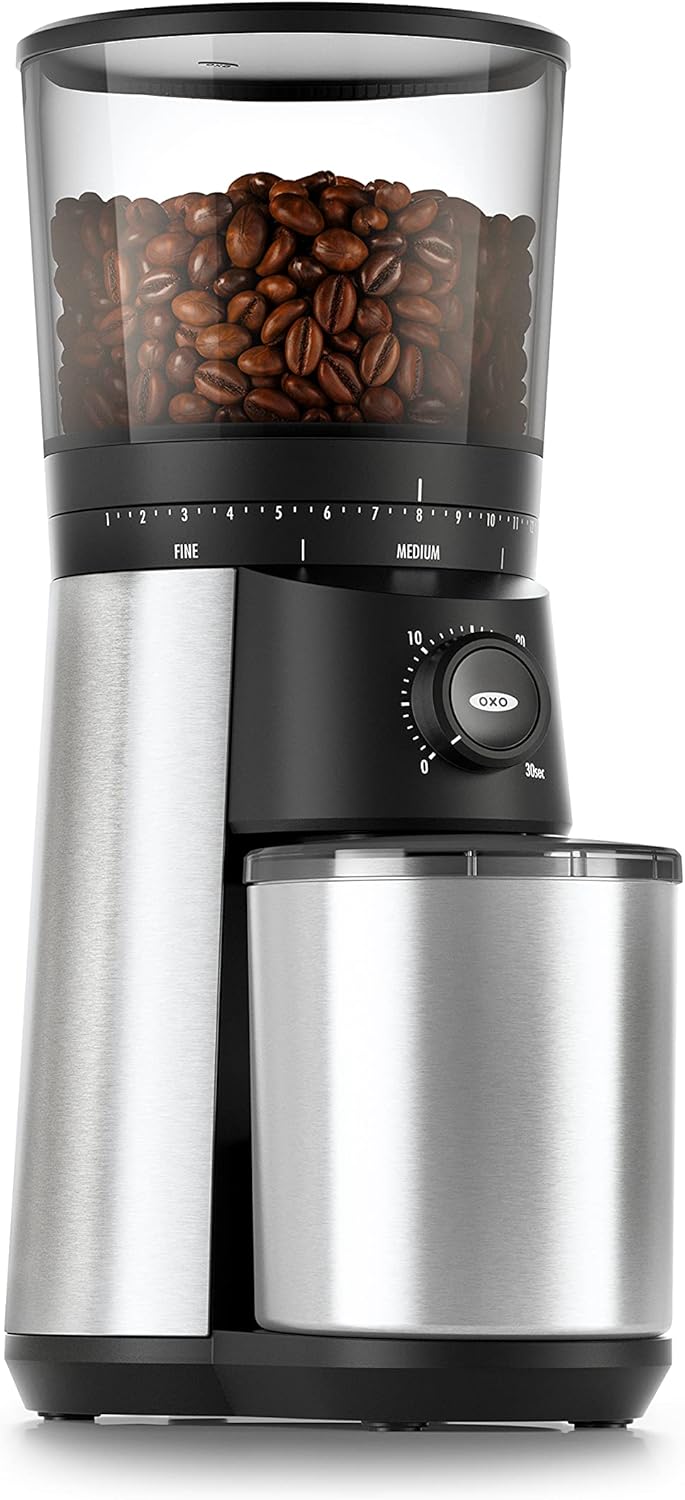
If you would rather start from a short list, these are popular options on Amazon for this search. Check each listing’s details, size and current price before you buy.


FAQ
Is stepless adjustment always better for espresso?
Stepless adjustment gives you the finest possible control, which is ideal for dialing in espresso. However, a stepped grinder with very small step sizes (so-called micro-steps) can work well if the steps are fine enough to let you tune the shot. Stepless is preferred by many, but it is not mandatory for great espresso at home.
How much retention is acceptable for single dosing?
For single dosing, look for a grinder that retains less than a few tenths of a gram. Some grinders designed for single dosing retain almost nothing. High retention means stale coffee mixes with fresh grounds, which reduces shot quality.
Should I buy a grinder with a portafilter fork or a dosing cup?
Both styles work well. A portafilter fork is convenient if you use the same portafilter every time. A dosing cup allows you to weigh the output and distribute the grounds before dosing, which can improve consistency. Many home baristas prefer dosing cups for single dosing.
Do larger burrs make better espresso?
Larger burrs generally produce a more consistent particle size and can grind faster, but they also cost more and generate more heat. For home use, quality 40–50 mm burrs are more than capable of excellent espresso. Larger burrs are beneficial if you grind large amounts of coffee regularly or want the fastest possible workflow.
Putting It All Together
Choosing an espresso grinder means balancing precision, retention, workflow, and budget. Stepless adjustment and single dosing give you the control to dial in shots consistently, while low retention keeps each dose fresh. Burr size and motor matter, but not as much as the ability to make small, repeatable adjustments. Start by deciding your preferred workflow, then look for a grinder that offers the adjustability and low retention that espresso demands.
For more on choosing a grinder, see our guides on espresso grinders and coffee grinders. If you are comparing grind sizes, the coffee grind size chart is a helpful reference.


