
 By Claire Whitaker
Updated November 2026
The brewista smart coffee scale is a compact digital scale aimed at home brewers who pour over, make espresso, or want to repeat the same recipe every morning. The listing for the Brewista Smart Coffee Scale III describes a 2kg capacity, 0.1g resolution, an automatic timer, rechargeable power and five operating modes. This review looks at those stated specifications, the design choices they imply, and the patterns owners tend to mention. It is based on research into the listing and general owner feedback, not on hands-on testing. Buy this scale if you already brew with a gooseneck kettle or espresso machine and want to track dose, water and time together. Skip it if you only need a basic kitchen scale for occasional measuring, or if you want a scale with a large platform for weighing equipment.
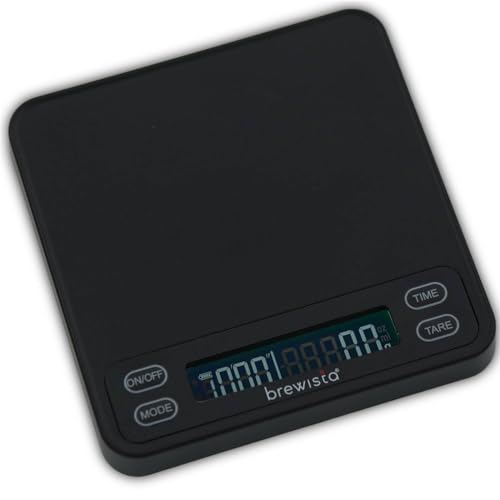
Brewista Smart Coffee Scale III with Timer, 2kg/0.1g High Precision Scale for Espresso and Pour-Over Coffee, Portable Mini Digital Kitchen Scale with Automatic Timing, Rechargeable, 5 Modes
Product Overview
The Brewista Smart Coffee Scale III is a portable digital scale built for coffee preparation. Its main job is to weigh ground coffee going into a basket or filter, then weigh water as it goes into the brew. Most people use it in two ways: as a dosing scale that weighs beans or grounds before brewing, and as a brew scale that tracks water weight and elapsed time during a pour.
The product is sold as a mini scale rather than a full kitchen scale. That means a smaller weighing surface and a footprint that fits next to a grinder or on a countertop beside a pour-over setup. The timer is built in, so you do not need a separate stopwatch or phone app. The rechargeable battery is a practical feature for a device that sits on the counter and gets moved often.
If you are new to measuring coffee by weight, it helps to understand why a scale beats scoops. Volume measurements change with grind size, bean density and how loosely you fill the scoop. Weight stays consistent. For more on that tradeoff, see Coffee Scoops and Measuring Coffee Without a Scale, which compares the two approaches in plain terms.
Key Features & Specifications
The table below lists the specifications named in the product listing. Values are taken as stated by the listing and should be confirmed on the product page before purchase.
| Feature | Specification | Why It Matters |
|---|---|---|
| Maximum capacity | 2 kg | Enough for dosing beans, grounds and full pour-over brews |
| Resolution | 0.1 g | Fine enough to dial in small dose changes for espresso |
| Built-in timer | Automatic timing | Lets you track bloom and extraction time without a separate timer |
| Operating modes | 5 modes | Covers different weighing and timing workflows |
| Power | Rechargeable | No battery swaps needed for regular use |
| Design | Portable mini digital scale | Compact footprint for small counters and travel |
| Intended use | Espresso and pour-over coffee | Matches the brew methods most home baristas use |
The 2kg capacity is the figure that matters most for coffee work. A brew of 1 to 2 liters of water, plus a carafe or dripper on top, fits comfortably. Users weighing a full carafe plus water can approach the limit, so it helps to tare the container first and keep an eye on total load. The 0.1g resolution is the standard for espresso dosing, where a difference of half a gram can change extraction noticeably.
Five modes are listed, though the exact set of modes is best confirmed in the product manual. In general, scales in this category switch between plain weighing, weighing with timing, and brew-specific tracking. If you want to understand what a dedicated brew scale adds beyond a plain kitchen scale, read Espresso Scale vs Kitchen Scale for Coffee.
Pros & Cons
Pros
- Stated 0.1g resolution suits espresso dosing and small adjustments in pour-over recipes.
- Built-in timer reduces the number of devices you need on the counter during a brew.
- Rechargeable battery avoids the recurring cost and waste of replacement batteries.
- Compact mini design fits beside a grinder and packs easily for travel.
- Five modes give flexibility across different brewing workflows.
- 2kg capacity covers typical dripper, carafe and water loads for home brewing.
Cons
- A small weighing platform can feel cramped with large vessels or wide kettles.
- Owners sometimes report that the scale needs a short warm-up or re-taring between weighings.
- The timer and mode controls take a little practice to use without looking at the instructions.
- Not suited to weighing heavy kitchen items or very large loads.
- Rechargeable batteries lose capacity over time, so a long-term replacement plan is worth considering.
Performance Analysis
Because this review is research-based, performance is assessed from the listed specifications and from patterns that appear in owner feedback, not from measured results. Here is how the specs translate into real use.
Accuracy at small doses
A 0.1g resolution is the threshold most coffee guides recommend for espresso. For a 18g dose, a 0.1g step represents about half a percent of the dose. That is fine enough to notice when a grinder setting shifts and the basket is slightly over or under. Owners generally describe scales in this class as responsive for dosing, though small drift can appear if the surface is bumped or the scale is not on a level counter.
Timing during pour-over
A built-in timer that starts with a weighing action is convenient for pour-over. A typical recipe might call for a 30 to 45 second bloom with about twice the coffee weight in water, followed by pours totaling a set weight by a target time of around three to four minutes. Having the timer on the same device as the weight means you can glance at both numbers without moving your eyes between a phone and a scale. Check whether your chosen mode starts timing automatically when water hits the scale, since that behavior determines how you should pour.
Battery and daily use
Rechargeable power is a reasonable fit for a countertop coffee tool. Owners who use a scale every morning tend to recharge on a weekly or every-few-days schedule, depending on how often they use the timer. Keep the charging cable within reach so the scale does not run flat mid-brew.
Footprint and stability
The mini format is an advantage for small kitchens and a limitation for large vessels. A wide gooseneck kettle or a tall carafe may overhang the platform. Wide, shallow dripper stands usually fit, but test the setup before committing to a brewing routine. If you regularly use a large carafe, a scale with a bigger surface may suit you better.
Who Should Buy This Product?
This scale is a good match for home brewers who have moved past scoops and want repeatable results. It suits people who pour over with a dripper and carafe, pull espresso shots and want to log dose and yield, and who value having a timer built into the same device. It also works for anyone who travels with brewing gear and wants something light and rechargeable.
It is a weaker choice for people who mainly bake or cook and need a platform for large bowls. It is also less suited to anyone who wants a scale with advanced app logging or a large touchscreen, since this product is built around simple controls. If you only brew once a week and do not care about precise repeatability, a basic scale or scoop may be enough.
Buying Guide
Before buying any coffee scale, decide which brew methods you use most. Espresso needs 0.1g resolution and quick response. Pour-over benefits from a timer that tracks bloom and total brew time. Batch brewing needs enough capacity for the carafe and water combined. Match the scale to your main method rather than the rarest one.
Check capacity against your heaviest setup. Weigh your empty dripper, carafe and typical water volume, then compare that total with the stated 2kg limit. Confirm the platform size against your kettle and vessels. Look for a rechargeable battery if you plan to use the timer often, and read the manual for the difference between the modes before you buy, since mode behavior is one of the most common sources of confusion.
Several well-known alternatives cover similar ground, and each suits a slightly different user.
- TIMEMORE Coffee Scale Basic 2.0: an electronic espresso scale with water flow rate and timer functions. It suits users who want flow-rate feedback alongside weight and time.

TIMEMORE Coffee Scale Basic 2.0 Electronic Espresso Scale with Water Flow Rate and Timer Function, Digital Scale for Kitchen/Baking/Cooking, Black
- Maestri House S2 Espresso Coffee Scale: a USB-C rechargeable espresso and pour-over scale with 0.1g precision, dual timing modes and a borosilicate glass top. It suits users who want a glass surface and dual timing options.

Maestri House S2 Espresso Coffee Scale with Timer, 0.1 g Precision | USB-C Rechargeable Espresso & Pour-Over Coffee Scale, 2 kg/0.1 g, Dual Timing Modes, Borosilicate Glass Top
For a broader comparison of options, see 6 Best Smart Coffee Scales for Pour-Over and Espresso (2026) and How to Evaluate Coffee Scales, Frothers and Espresso Tools.
FAQ
Is the brewista smart coffee scale accurate enough for espresso?
The listing states 0.1g resolution, which is the level most espresso guides recommend for dosing. Accuracy also depends on a level surface, a stable counter and consistent tare habits. Owners generally find it workable for espresso when those conditions are met.
Does it work for pour-over and batch brewing?
Yes, the stated 2kg capacity and timer make it suitable for pour-over. For batch brewing, add up the weight of the carafe, dripper and water, and confirm the total stays under the limit before you start.
Can I use it as a regular kitchen scale?
You can, but it is built for coffee. The small platform and 2kg limit make it a poor fit for baking bowls or large grocery weighing. A standard kitchen scale is better for those jobs.
How long does the battery last?
The listing describes a rechargeable battery but does not give a runtime figure that can be confirmed here. Owners who use the scale daily often recharge every few days, so charge it regularly and keep the cable nearby.
Do I need a separate timer?
Not if you use the built-in timer. The timer is designed to run alongside weighing, so most users can skip a stopwatch entirely.
Does it need calibration?
Check the manual for calibration steps. Many digital scales are calibrated at the factory, but if readings drift after a bump or a move, follow the manufacturer’s recalibration procedure.
What should I read before buying a dosing scale?
If you are comparing dosing-focused models, Brewista Coffee Gear Dosing Scale: How to Choose and Use One Well covers what to look for and how to use one well.
Related reading
- 7 Best Smart Z Digital Coffee Scale Picks for Home Brewing (2026)
- 7 Best Motif Mentor Smart Coffee Scale Options for Home Brewing (2026)
- 5 Best Smart Barista Coffee Scales with Timer V2 Options for Home Brewing (2026)
About Claire Whitaker
Claire Whitaker is part of our editorial team and reviews and edits our coffee gear & accessories guides, checking product details against manufacturer specifications and owner feedback.



