By Claire Whitaker
Updated November 2026
The Weightman coffee scale with timer is a small, inexpensive digital scale aimed at home brewers who want to weigh coffee and water without taking up much counter space. It suits people who pour-over occasionally, use a moka pot or AeroPress, or want a travel-friendly scale that also handles tea and kitchen weighing. It is a weaker fit for serious espresso enthusiasts who need a flat, high-capacity platform, a built-in flow-rate display, or a scale designed for daily heavy use. Buyers who want a premium build, rechargeable batteries, or dual timing modes should look at higher-end alternatives instead. This review is based on manufacturer specifications and common owner feedback patterns, not hands-on testing.

WEIGHTMAN Espresso Scale with Timer 1000g x 0.1g, Small Thin Coffee Scale | Mini Digital Scale Grams and Ounces with Large Backlit LCD Stainless Steel Pocket Food Scale Drip Tray Pulling Scale
Product Overview
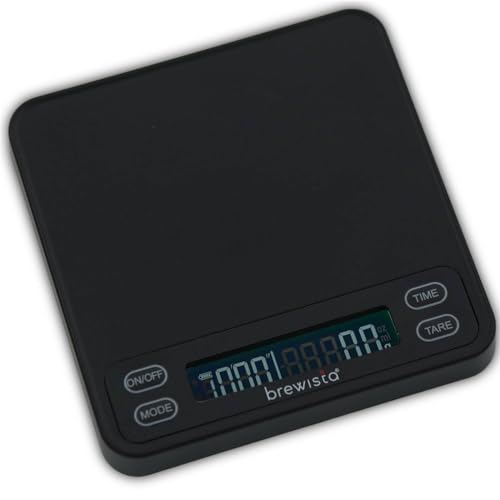
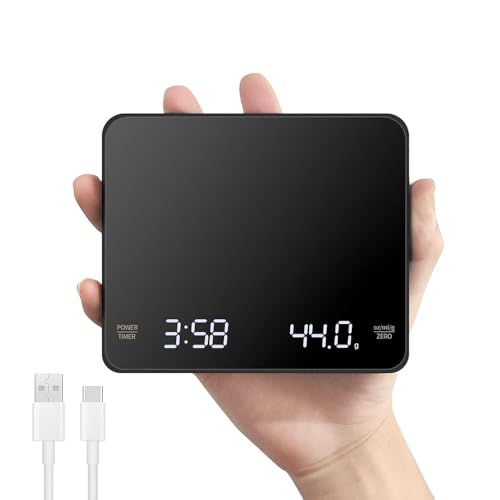
The WEIGHTMAN Espresso Scale with Timer is a compact digital scale with a stainless steel top, a large backlit LCD, and a tray designed to sit under a dripper or cup. The listing describes it as a 1000 g by 0.1 g scale, meaning it reads in tenths of a gram up to a 1000 gram capacity. It is marketed for espresso, pour-over, and general food weighing, and the listing also mentions a pocket-sized, thin profile that makes it easy to carry.
The product sits in the mini digital scale category rather than the larger brewing-focused scales with flow-rate tracking and auto-start timers. In practice, that means it does what most home brewers need for dosing and pour totals, but it does not try to be a full brewing system. The built-in timer is a basic countdown and stopwatch function, which is useful for tracking bloom and total brew time, but it is not tied to automatic start on water flow.
Key Features & Specifications
| Specification | Detail (per listing) |
|---|---|
| Maximum capacity | 1000 g |
| Readability | 0.1 g |
| Units | Grams and ounces |
| Display | Large backlit LCD |
| Top surface | Stainless steel |
| Included accessory | Drip tray |
| Timer | Built-in timer function |
| Form factor | Small, thin, pocket-style |
Because the listing does not publish battery type, exact dimensions, or timer resolution in detail, treat those points as things to confirm on the product page before buying. Manufacturers of scales in this class commonly specify auto-off timing and battery life, so check those figures directly.
Pros & Cons
Pros
- Compact, thin profile that fits in a bag or small drawer.
- 0.1 g readability is sufficient for standard coffee doses and pour-over water totals.
- Backlit display is easier to read in dim kitchens or early-morning brewing.
- Includes a drip tray, which helps catch spills under a dripper or mug.
- Grams and ounces modes make it usable beyond coffee, including tea and baking.
- Budget-friendly option for someone adding their first scale.
Cons
- The timer is a basic countdown and stopwatch, not an automatic flow-triggered timer.
- A 1000 g capacity is more than enough for coffee but leaves little room for large brew batches on a heavy vessel.
- Small footprint and thin base can feel less stable than broader scales when pouring quickly.
- Owners sometimes report that small scales of this type need careful calibration and occasional re-zeroing.
- Build materials and long-term durability are less established than with well-known brewing brands.
Performance Analysis
On paper, a 0.1 g readout is the important number for brewing. A typical pour-over dose of 15 to 20 grams of coffee, or an espresso dose of 18 to 20 grams, is well within what a 0.1 g scale can resolve. For water, a 250 gram pour-over is measured in increments that are precise enough for most home recipes. The limitation is less about resolution and more about repeatability: small scales are sensitive to how the surface sits on the counter and how fast the dripper is placed on the tray.
Owner feedback patterns for scales in this category tend to focus on three themes. The first is responsiveness: many users appreciate a quick settling time, but some report a short lag when pouring steadily. The second is the timer: users who want a simple stopwatch for bloom and total time generally find it adequate, while those expecting automatic start-on-flow usually look elsewhere. The third is convenience: the thin profile and backlight are commonly praised for travel and low-light use.
For espresso, the main consideration is the footprint. A small, thin scale fits under a portafilter basket or next to a machine, but it leaves little margin if you are weighing a large shot glass or a bulky tamper stand. For pour-over, the tray is helpful, though a wider platform gives more stability when kettle pouring. In short, the scale performs well for its intended role, with the trade-off being a simpler feature set.
Who Should Buy This Product?
This scale is a good match if you brew pour-over or espresso at home and want an accurate, compact scale without paying for advanced features you may not use. It is also a practical choice for travelers, people with limited counter space, and anyone who weighs food, tea, or baking ingredients alongside coffee. If you are starting out and want to learn ratios before investing in more gear, it works well as a first scale.
You should skip it if you need automatic flow-rate timing, a very large platform for big drippers or carafes, rechargeable batteries with a documented charging system, or a scale built for heavy daily commercial use. Those needs point toward higher-end brewing scales with dedicated timers and wider bases.
Buying Guide
When choosing any coffee scale with a timer, start with four questions. First, what is the readability? Look for 0.1 g for brewing; 1 g is too coarse for small espresso doses. Second, what is the capacity? For pour-over, 2 kg is a comfortable ceiling, but 1000 g covers most home recipes. Third, how does the timer work? A manual start is fine for most people, but automatic start on water flow saves attention during pours. Fourth, how stable is the base? A wider footprint reduces tipping and drift during fast pours.
If you want a similar compact scale with a timer and a similar 1000 g by 0.1 g spec, the WEIGHTMAN Small Coffee Scale with Timer is a close relative of the product reviewed here.

WEIGHTMAN Small Coffee Scale with Timer, 1000g x 0.1g, Mini Espresso Scale | Stainless Steel Food Scale for Grams and Ounces, Large Backlit LCD, Travel Pocket Scale for Pour Over Coffee, Tea and Bakin
If you want a rechargeable option with dual timing modes and a borosilicate top, the Maestri House S2 Espresso Coffee Scale with Timer is worth comparing. Its 2 kg capacity and USB-C charging suit people who weigh larger batches or prefer not to replace batteries.

Maestri House S2 Espresso Coffee Scale with Timer, 0.1 g Precision | USB-C Rechargeable Espresso & Pour-Over Coffee Scale, 2 kg/0.1 g, Dual Timing Modes, Borosilicate Glass Top
For a broader overview of models in this category, see Top 6 Hero Coffee Scales with Timer Models for Home Brewing and Does a Coffee Weighing Scale with Timer Improve Your Brew? Here's Why, which explain how timers and readability affect brewing consistency.
FAQ
Is the Weightman coffee scale with timer accurate enough for espresso?
A 0.1 g readability is sufficient for standard espresso doses of 18 to 20 grams. Accuracy also depends on calibration and placement, so zero the scale before each dose and keep it on a level surface.
Does the built-in timer start automatically when I pour water?
The listing describes a timer function, but it does not describe automatic start on water flow. Plan on starting the timer manually. If you want auto-start, look at a dedicated brewing scale with flow sensing.
Can I use it for tea and baking as well?
Yes. Grams and ounces modes make it usable for tea leaves, sugar, flour, and other kitchen ingredients within its 1000 gram capacity.
Does it come with batteries?
Check the current product listing for battery details. Many scales in this class use replaceable batteries, and owners generally recommend keeping spares.
Is it stable enough for pouring over a Chemex or large dripper?
The compact, thin base may feel less stable with large or heavy vessels. Owners often report using the included drip tray and pouring slowly to reduce movement.
How do I calibrate a small pocket scale?
Place the scale on a flat surface, turn it on, and confirm it reads zero with no load. If it drifts, check the manufacturer instructions for calibration steps, and avoid placing it on uneven or vibrating surfaces.
Should I replace this with a more expensive scale?
If your main needs are dosing and pour totals, this type of scale is often enough. Upgrade if you need automatic flow timing, a larger platform, or heavier daily use.
Final Verdict
The Weightman coffee scale with timer is a sensible, compact choice for home brewers who want 0.1 g readability, a backlit display, and a simple timer without paying for advanced brewing features. It works well for pour-over, espresso dosing, and general kitchen weighing, and it is especially useful for travel or small counters. It is less suitable if you need auto-start flow timing, a wide platform, or a scale built for heavy daily use. Consult the current product page for battery, dimension, and warranty details before purchasing.
View on AmazonRelated reading
- Mini V60 Coffee Drip Scale with Timer: 6 Best Picks for Pour-Over
- Hario V60 Drip Coffee Scale and Timer: 6 Best Picks for Home Brewers
- Hario V60 Drip Coffee Scale and Timer Stainless Steel: 4 Best Picks Compared
- Hario V60 Drip Coffee Scale and Timer Black: Which to Buy and Why
About Claire Whitaker
Claire Whitaker is part of our editorial team and reviews and edits our coffee gear & accessories guides, checking product details against manufacturer specifications and owner feedback.