By Claire Whitaker
Updated November 2026
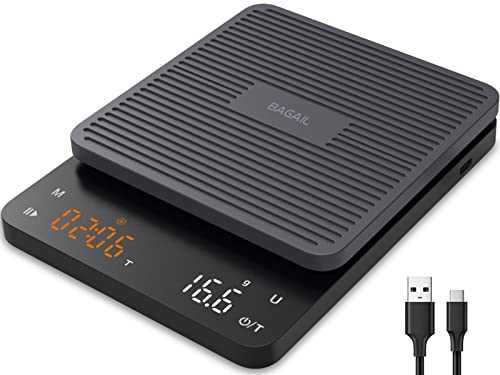
The Bonavita rechargeable coffee scale is worth considering if you brew at home and want a compact, cordless scale you can recharge instead of feeding it batteries. It handles the core job well: weighing coffee and water to the gram so your recipe stays repeatable. Whether it suits you depends mostly on how you brew and where you plan to keep it.
Why a Rechargeable Scale Appeals to Home Brewers
Most kitchen scales run on coin cells or AAA batteries, and those tend to die at the worst moment, usually halfway through a pour-over. A rechargeable model removes that uncertainty. You charge it on a schedule, similar to a phone, and the scale stays ready on the counter. For people who brew daily, that consistency matters more than any single feature on the spec sheet.
Shopping for one? See our guide: OXO Conical Burr Coffee Grinder with Integrated Scale: 7 Best Picks (2026).
Rechargeable scales also tend to be slimmer, which helps on a crowded counter. If you use the scale under a dripper or beside a kettle, a low profile and a flat, stable platform will make your life easier.
What to Check Before You Buy
Look at these factors before committing to any rechargeable coffee scale:
- Resolution: A reading of 0.1 g is the usual target for pour-over and espresso. Coarser readings make small adjustments hard to judge.
- Capacity: Most home recipes weigh under 1 kg in total, but a larger platform helps if you also weigh a carafe.
- Timer: A built-in timer lets you track bloom and drawdown without a second device. The Coffee Scale with Timer guide on this site covers how timers fit into pour-over routines.
- Charging method and runtime: Check the manufacturer’s stated battery life and charging port. Owners often report that a scale used daily needs a charge every week or two, but confirm the figures in the product documentation.
- Auto-off: Make sure it sleeps when idle so it doesn’t drain between brews.
If you pull espresso, a scale with a fast response time matters more than extra capacity. The article Espresso Scale vs Kitchen Scale for Coffee explains the differences in more detail.
How to Get Consistent Results With Any Coffee Scale
A scale only improves your coffee if you use it the same way each time. Follow these steps:
- Tare the scale with your empty brewer or vessel on top.
- Weigh your coffee dose, then grind. Weighing beans rather than scooping is more repeatable, as covered in Coffee Scoops and Measuring Coffee Without a Scale.
- Start your timer as you begin pouring, and keep a note of total water weight.
- Keep the scale on a flat, level surface, away from splashes that can affect readings.
- Charge the scale on a regular schedule so it never dies mid-brew.
A good starting point for many pour-over recipes is a ratio near 1:15 to 1:17 (coffee to water by weight), but adjust to your taste and beans.
What We’d Use
If you want a rechargeable scale with a timer for pour-over, look for a compact model with a flat platform and clear display. View on Amazon
If you also grind at home and want the scale built into your setup, an integrated grinder can simplify your counter. View on Amazon
FAQ
Is a rechargeable coffee scale better than a battery one?
For daily use, it usually is. You avoid sudden battery failure, and charging is simpler than replacing cells. Battery models can still work well if you brew occasionally.
How precise does a coffee scale need to be?
Aim for 0.1 g resolution. That is fine enough for most pour-over and espresso recipes, and it is the standard most home brewers use.
Can I weigh my brewer and carafe on the same scale?
Yes, as long as the platform is large enough and the total weight is within the scale’s capacity. Always tare before adding coffee or water.
Related reading
- Kitchen Scale for Coffee: A Step-by-Step Guide to Consistent Brews (2026)
- How to Evaluate Coffee Scales, Frothers and Espresso Tools
- Hard Water and Your Coffee Maker: Scale, Taste and Fixes
Ready to choose one?
About Claire Whitaker
Claire Whitaker is part of our editorial team and reviews and edits our coffee gear & accessories guides, checking product details against manufacturer specifications and owner feedback.