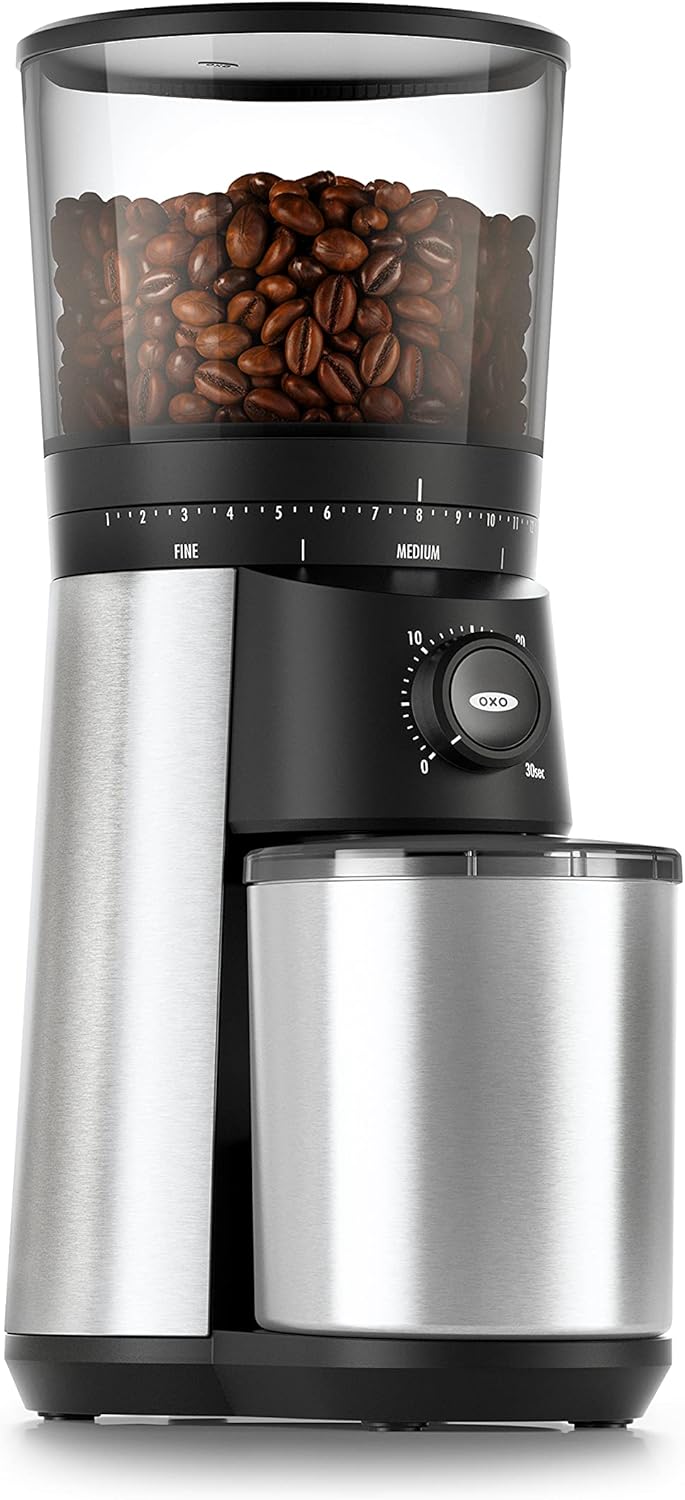
When you shop for a coffee grinder, the burr shape is one of the first specifications you see. Flat burrs and conical burrs both cut coffee beans into particles, but they do it in different ways. The geometry of the burrs affects the particle distribution, the heat transferred to the grounds, the noise level during grinding, and how easy it is to align the burrs for consistent results. Here is what actually differs between flat and conical burr grinders and how to choose the one that fits your home brewing routine.
The short answer
Flat burrs produce a more uniform particle size distribution with a slightly narrower spread of fines, which is often preferred for espresso. Conical burrs tend to create a broader particle distribution with more fines, which can add body to drip coffee and espresso. Many flat burr grinders spin faster and can run warmer and louder, while many conical grinders run slower and quieter, though the motor and design matter. Conical burrs are generally easier to align out of the box, but flat burrs offer more adjustability for advanced users. Neither shape is inherently better; the specific grinder design, burr quality, and your brew method matter far more than the burr shape alone.
How each burr shape works
Flat burrs
Flat burrs consist of two flat, ring-shaped cutting surfaces that face each other. One ring rotates while the other remains stationary. Coffee beans fall into the center and are pulled outward by centrifugal force as they are cut between the two surfaces. The gap between the burrs determines the particle size. Because the cutting action happens across the entire face of the burrs, the particles travel a consistent distance from the center to the edge, which tends to produce a more uniform particle distribution. The high rotational speed of flat burrs generates more heat and noise compared to conical designs. Alignment of flat burrs requires the two rings to be perfectly parallel; even a small misalignment can cause uneven particle sizes and increased fines.
Conical burrs
Conical burrs use a cone-shaped inner burr that rotates inside a stationary outer ring. The cone has a series of cutting teeth, and the outer ring has matching ridges. Coffee beans are drawn downward through the gap between the cone and the ring, and the beans are cut multiple times as they travel from the top to the bottom. This repeated cutting action tends to produce a broader particle distribution with more fine particles. Conical burrs typically operate at lower rotational speeds, which generates less heat and less noise. The alignment of conical burrs is often simpler because the cone self-centers inside the outer ring, reducing the need for precise shimming. However, the particle size adjustment on some conical grinders can be less repeatable than on flat burr designs.
Side-by-side comparison table
| Characteristic | Flat burrs | Conical burrs |
|---|---|---|
| Particle distribution | Narrower, more uniform | Broader, more fines |
| Common flavor tendency | Brighter, more clarity | Fuller body, more sweetness |
| Heat buildup | Higher | Lower |
| Noise level | Louder | Quieter |
| Rotational speed | Higher RPM | Lower RPM |
| Ease of alignment | More involved | Simpler, self-centering |
| Typical price class | Wide range, from entry to pro | Wide range, including many budget and hand grinders |
| Retention | Varies by design | Varies by design |
When flat burrs are the better choice
Flat burrs are commonly preferred for espresso brewing because the more uniform particle distribution helps produce consistent extraction and a cleaner flavor profile. If you primarily make espresso and want bright, nuanced flavors with clear separation of tasting notes, a flat burr grinder is a strong option. The narrower particle spread reduces the chance of channeling during espresso extraction, which can lead to more repeatable shots.
Flat burrs also offer more flexibility for advanced users who want to fine-tune alignment. Many flat burr grinders allow you to shim the stationary burr to achieve perfect parallelism, which can further improve particle uniformity. This adjustability is valuable if you are willing to spend time calibrating your grinder for peak performance.
For brew methods that benefit from a clean cup, such as pour-over or drip coffee, flat burrs can produce a brighter, more tea-like flavor. The reduced fines mean less sludge in the bottom of your cup and a cleaner mouthfeel. However, some drinkers find that flat burrs can produce a slightly hollow or thin body if the coffee is ground too uniformly without enough fines to add texture.
Flat burr grinders span a wide price range, from entry-level models suitable for beginners to professional-grade units used in cafes. You can find a flat burr grinder at almost any budget level, though the build quality and consistency vary significantly between models.
When conical burrs are the better choice
Conical burrs are often recommended for brew methods where body and mouthfeel matter, such as espresso with milk drinks, French press, or cold brew. The broader particle distribution with more fines adds texture and can make the coffee taste fuller and sweeter. Many home baristas find that conical burrs produce espresso with more forgiving extraction, meaning you can achieve a balanced shot with slightly less precise technique.
If you value a quieter, cooler grinding experience, conical burrs are generally the better choice. The lower rotational speed means less heat is transferred to the coffee grounds, which can help preserve volatile aromatic compounds. This is especially noticeable during longer grinding sessions for multiple cups or larger batch brews.
Alignment is simpler with conical burrs because the cone naturally centers itself inside the outer ring. This makes conical grinders more user-friendly for those who do not want to spend time shimming or adjusting the burrs. Out-of-the-box performance is often more consistent with conical designs, especially in mid-range grinders.
Conical burrs also tend to retain fewer grounds inside the grinding chamber, depending on the specific design. The downward path of the coffee through the cone helps push particles out, reducing the amount of stale coffee that mixes into your next dose. However, retention varies widely between models, so it is worth checking the manufacturer’s specifications for the particular grinder you are considering.
Manual versus electric grinders
The choice between flat and conical burrs also intersects with the decision to use a manual or electric grinder. Manual grinders mostly use conical burrs because the lower rotational speed and the self-centering design make hand grinding more efficient and comfortable. The slower cutting action of a manual conical grinder generates very little heat, which can preserve flavor, and the quiet operation is a bonus for early morning brewing. Manual grinders also tend to be more portable and do not require a power outlet.
Electric grinders are available with both flat and conical burrs. Electric flat burr grinders are common in espresso-focused setups, while electric conical burr grinders are popular for drip coffee and all-purpose use. Electric conical grinders often run at lower RPM than their flat counterparts, but the motor still generates some heat. If you grind large amounts of coffee daily, an electric grinder is more convenient regardless of burr shape.
For home use, a manual conical grinder can produce excellent particle quality at a lower cost than an electric flat burr grinder. However, manual grinding requires physical effort and time, especially for fine espresso settings. If you make multiple espresso shots in a row or brew large batches, an electric grinder is more practical.
Upkeep and long-term ownership
Both flat and conical burrs require periodic cleaning and occasional replacement. Coffee oils and fines accumulate on the burr surfaces over time, which can affect flavor and grind consistency. You should clean your burrs every few weeks or whenever you notice a change in taste or grind quality. A stiff brush and a vacuum are usually sufficient for routine cleaning. Some grinders allow you to remove the burrs for deeper cleaning, while others require you to clean them in place. Check the manufacturer’s instructions for your specific model.
Burr replacement is necessary when the cutting edges become dull. Dull burrs produce more fines and inconsistent particle sizes. The lifespan of burrs depends on how much coffee you grind and the hardness of the beans. Burr life varies widely with the burr material and how much you grind, so follow the manufacturer’s guidance. You can inspect the burrs for visible wear or chipping to decide when to replace them.
Alignment maintenance is more relevant for flat burrs. Over time, vibration or disassembly can shift the burr alignment. If you notice a sudden change in grind consistency or increased fines, realigning the flat burrs may restore performance. Conical burrs rarely require alignment adjustments because the self-centering design remains stable.
Retention is a factor in long-term ownership. Some grinders trap a small amount of grounds inside the burr chamber after each use. This retained coffee can become stale and mix into your next grind, affecting freshness. Conical burrs generally have lower retention due to the downward path, but the design of the exit chute and anti-static features also matter. You can reduce retention by using a bellows or tapping the grinder, but the most effective solution is to choose a model with low retention from the start.
FAQ
Which burr shape is better for espresso?
Flat burrs are more commonly used for espresso because they produce a more uniform particle distribution, which helps with consistent extraction and clarity. Conical burrs can also produce excellent espresso, especially if you prefer a fuller body and more forgiving shots. The specific grinder design matters more than the burr shape alone.
Do conical burrs produce more fines?
Yes, conical burrs tend to produce a broader particle distribution with a higher proportion of fine particles compared to flat burrs. This is due to the multiple cutting stages as the coffee travels downward through the cone. The extra fines can add body to the cup but may also lead to slower drainage in drip brewers.
Are flat burr grinders louder than conical?
Generally, yes. Flat burrs operate at higher rotational speeds, which generates more noise from both the motor and the cutting action. Conical burrs run at lower RPM and are typically quieter. If noise is a concern, a conical grinder or a manual grinder is a better choice.
Can I switch between flat and conical burrs on the same grinder?
No, the burr chamber and drive mechanism are designed for a specific burr shape. You cannot swap flat burrs into a conical grinder or vice versa. You would need to purchase a separate grinder with the other burr type if you want to compare the two designs.
Choosing between flat and conical burrs comes down to your brewing priorities. If you value clarity and uniformity for espresso, flat burrs are a strong match. If you prefer a fuller body, quieter operation, and simpler alignment, conical burrs will serve you well. The specific grinder design, build quality, and your own palate will ultimately determine which shape produces the coffee you enjoy most. For more comparisons between grinder types, see the grinder comparisons guide and the broader coffee equipment comparisons section.