By Claire Whitaker
Updated November 2026
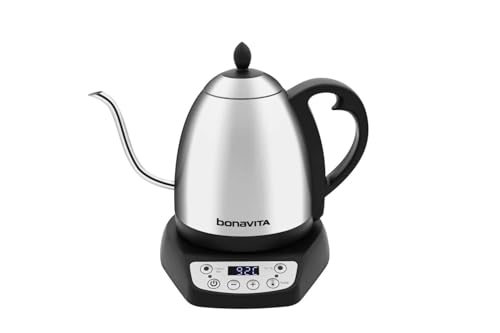
A gooseneck kettle with temperature control lets you heat water to a set number and hold it there, so your pour-over brews stay consistent from cup to cup. This guide explains what to look for, how to set up your kettle for a typical brew, and the mistakes home brewers often mention when they compare notes in online coffee communities. Reddit threads on this topic tend to center on the same few points, and this article covers them in order.
What Temperature Control Actually Does for Your Brew
A standard kettle boils water and shuts off. A temperature-controlled gooseneck kettle lets you pick a target, usually somewhere between the low 180s and 212°F, and holds the water near that number. Owners frequently report that this matters most for light roasts, which often taste best with water in the upper 190s to 205°F range. Darker roasts tend to do well a few degrees cooler. For more on target numbers, see Water Temperature for Each Brew Method.
Shopping for one? See our guide: Bodum Bistro Gooseneck Kettle (2026): Which Should You Choose?.
Checking the Features Before You Buy
Most Reddit discussions boil down to a short list of features. Look for these first:
- Selectable temperature presets or a fine-step dial, so you can match a specific roast.
- A hold function that keeps water at temperature for a set time, since most pour-overs take three to four minutes.
- A spout that gives you a slow, controlled stream. The spout matters as much as the heating element.
- A visible display or clear indicator, so you know the kettle has reached target.
If you are comparing styles, Electric Gooseneck Kettle with Temperature Control: How to Choose and Use One covers the core tradeoffs in more detail, and Variable Temperature Kettles: Hold Functions, Accuracy and Brew Temperatures explains what hold functions do in practice.
How to Set Up and Use Your Kettle
- Fill the kettle with fresh, filtered water. Avoid filling above the max line.
- Select your target temperature. For a medium roast, many brewers start around 200°F.
- Let the kettle reach temperature and hold. Wait for the indicator before you start.
- Rinse your filter and dripper with hot water, then discard the rinse water.
- Add ground coffee, then pour in slow concentric circles, keeping the water level steady.
- Stop pouring when you reach your target water weight and let the bed drain.
For pouring technique, see How to Pour with a Gooseneck Kettle for Better Pour-Over.
Adapting the Kettle to Different Brew Methods
A gooseneck kettle with temperature control works across pour-over setups, though the best settings change with the dripper. Owners of cone drippers and Chemex-style brewers often mention that the wider spout and slower flow help with even saturation. For specifics, see Gooseneck Kettle for Chemex: How to Choose and Pour Like a Pro. If you are weighing electric against stovetop models, Stovetop vs Electric Gooseneck Kettles lays out the differences.
Common Mistakes to Avoid
- Setting the temperature too high for light roasts, which can taste sharp or sour.
- Skipping the hold step and pouring before the kettle is fully stable.
- Using water with heavy mineral content, which can affect both taste and the kettle’s internals.
- Forgetting to descale on schedule. Check the manufacturer’s cleaning guidance and How to Clean Gooseneck Kettle: Step-by-Step Guide for Home Brewers.
- Pouring too fast, which disturbs the coffee bed and causes uneven extraction.
Recommended Gear
- Digital gooseneck kettle with temperature presets: The most useful choice for matching water temperature to each roast. View on Amazon
- Precision digital scale: Helps you measure water and coffee by weight, which makes pour-overs repeatable. View on Amazon
- Pour-over dripper set: A stable dripper gives the kettle’s controlled stream something to work with. View on Amazon
FAQ
Is a temperature-controlled gooseneck kettle worth it for everyday brewing?
If you brew several roasts or care about consistency, a set temperature is a practical upgrade. If you only brew one dark roast, a basic gooseneck may be enough.
What temperature should I start with?
Many brewers start around 200°F for medium roasts and adjust from there based on taste.
How long should I hold the water before pouring?
Hold until the indicator shows the target temperature. The kettle itself will not change your brew time, so wait for a stable reading.
Conclusion
A gooseneck kettle with temperature control gives you a repeatable starting point for every brew. Choose a model with presets, a steady hold function, and a controllable spout, then tune the temperature to your roast. Consistent water temperature is one of the simplest ways to make your pour-over taste the same way twice.
Ready to choose one?
About Claire Whitaker
Claire Whitaker is part of our editorial team and reviews and edits our coffee gear & accessories guides, checking product details against manufacturer specifications and owner feedback.