By Claire Whitaker
Updated November 2026
The Bonavita 1L digital gooseneck variable temperature electric kettle is aimed at home pour-over brewers who want to set a precise water temperature and hold it while they pour. It suits people who brew single cups or small batches, use a manual pour method like Hario V60 or Kalita Wave, and care about repeatable temperature. It is less suited to anyone who needs a large capacity for family brewing, wants a fully insulated thermal carafe-style kettle, or prefers a basic kettle with no temperature settings at all. The 1-liter capacity and 1200-watt heating element make it a practical middle-ground choice for daily use.
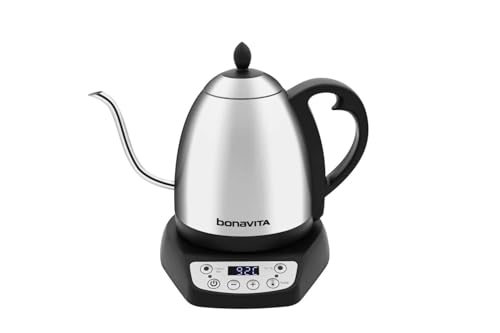
Bonavita 1L Digital Variable Temperature Gooseneck Electric Kettle for Coffee Brew and Tea Precise Pour Control, 6 Preset Temps, Café or Home Use, 1200 Watt, LED Panel, Stainless Steel
Product Overview
The Bonavita 1L Digital Variable Temperature Gooseneck Electric Kettle is a stainless steel kettle built around a narrow, curved spout that gives the pour control most pour-over brewers look for. Its listing describes it for coffee, brewing and tea, and for use in both cafés and homes. The defining feature is the digital control panel, which lets you choose a target water temperature rather than simply boiling and waiting. The LED panel shows the current temperature and the setting, so you can track the water as it heats.
Variable temperature matters because different coffees and brew methods respond differently to heat. Lighter roasts often benefit from hotter water, while darker roasts can taste harsh or bitter when extracted at high temperatures. A kettle that holds a specific temperature lets you adjust without guessing from the sound of bubbles or the color of steam. If you are new to this idea, the site’s guide on Variable Temperature Kettles: Hold Functions, Accuracy and Brew Temperatures explains how these settings translate into cup flavor.
The kettle is a good fit for someone who already owns a dripper, a burr grinder and a scale, and wants to tighten up the one variable that is hardest to control by eye. It is not a replacement for those tools. Think of it as the component that makes the rest of your setup more consistent.
Key Features & Specifications
The table below lists the specifications named in the product listing or that are widely associated with this model. Confirm exact details on the Amazon page before buying, since manufacturers occasionally revise materials or firmware.
| Feature | Specification |
|---|---|
| Capacity | 1 liter |
| Power | 1200 watts |
| Temperature control | Digital variable temperature |
| Preset temperatures | 6 presets, as stated in the listing |
| Display | LED panel |
| Body material | Stainless steel |
| Spout style | Gooseneck, for controlled pouring |
| Intended use | Coffee, brewing and tea; café or home |
Manufacturers of kettles in this class generally specify that water should not be run dry and that the kettle should be used on a dry base. Follow the included instructions for descaling and cleaning, and check the rated voltage before plugging in, since 1200-watt appliances draw significant current and should be on a circuit able to handle it.
Pros & Cons
Pros
- Digital temperature selection lets you target a specific brew temperature instead of estimating it.
- The LED panel shows the live temperature, which helps when you are timing a pour.
- The 1200-watt element heats a liter of water noticeably faster than a typical 1000-watt kettle.
- The gooseneck spout gives a slow, steady stream suited to even saturation of grounds.
- Stainless steel construction is durable and generally easier to keep clean than plastic-bodied models.
- One-liter capacity covers one to three pour-over cups without wasting heat on unused water.
Cons
- Owners often mention that the 1-liter size is too small for larger households or batch brewing.
- Temperature accuracy depends on the sensor and calibration; users with very precise targets should verify readings with a separate thermometer.
- Digital panels and multiple presets add a learning curve compared with a simple on/off kettle.
- Like most electric kettles, it needs regular descaling in hard-water areas to keep the heating element performing well.
Performance Analysis
Because this review is based on the listed specifications and recurring patterns in owner feedback rather than hands-on testing, it is worth thinking through what those numbers mean in practice. A 1200-watt heater with a one-liter tank typically brings water from room temperature to a boil in a few minutes. That speed matters less than the ability to stop at a set temperature. For pour-over, many brewers target somewhere in the low-to-mid 200s Fahrenheit, with lighter roasts sometimes brewed hotter and darker roasts cooler. A kettle that holds a chosen number lets you stay in that range through the whole brew rather than letting water slide as it sits.
Owners of digital variable temperature kettles commonly report that the presets are the most useful part of daily use. Rather than dialing in a new number every morning, you pick the setting you already know works for a given bean and go. The keep-warm behavior on kettles like this also tends to be a point of discussion: a hold function keeps water at temperature for a period, but water loses heat over time, and the rate depends on the kettle’s insulation. If you pour slowly over several minutes, a hold function is convenient; if you wait longer, you may want to reheat. For a detailed explanation of how hold functions and accuracy interact, see the site’s article on hold functions and brew temperatures.
Spout performance is where the gooseneck design earns its name. A narrow spout lets you direct water precisely onto the bed of grounds, which supports a steady, even pour. Owners of gooseneck kettles frequently note that control becomes easier with practice and that the flow rate depends on how much water is in the kettle, since pressure changes as the level drops. Keeping the water level in a consistent range helps maintain a predictable stream.
The main performance question is accuracy versus consistency. Most brewers care more about repeatability than an absolute reading. If the kettle consistently holds the same offset from your target, you can adjust your recipe to compensate. Where it becomes a problem is if the reading drifts between brews. Checking the kettle with an independent thermometer a few times is a reasonable way to learn how it behaves in your kitchen.
Who Should Buy This Product?
This kettle makes sense for home brewers who use a manual dripper, want a stable pour temperature, and brew one to three cups at a time. It is also a reasonable choice for people who like to experiment with bean-specific temperatures and want presets that make switching quick. Café or small office use is plausible given the stated café-use positioning, though high-volume operations will outgrow a one-liter tank quickly.
You should skip this kettle if you mainly make tea for a crowd, need to fill a large carafe, or simply want to boil water without thinking about settings. A basic stovetop or non-variable electric kettle will serve those needs for less complexity. People who prefer a fully sealed thermal carafe for hours of hold time may also want to look at a different style of kettle.
Buying Guide
Before buying any variable temperature gooseneck kettle, match the capacity to your typical brew. A one-liter kettle is comfortable for a few pour-over cups; if you regularly brew for four or more people, look for a larger tank. Next, check how the temperature is set. Some kettles offer a fine dial or a numeric keypad, while others use a fixed set of presets. The site’s guide on Electric Gooseneck Kettle with Temperature Control: How to Choose and Use One walks through these differences step by step.
Consider the hold function and how long it lasts. A kettle that keeps water at temperature for a short window suits quick brews, while longer holds help if you take your time. Also check whether the spout suits your pouring style. Thinner spouts give finer control but may pour more slowly, while wider spouts flow faster. Material matters too: stainless steel is durable and easy to wipe down, while glass lets you see the water level but is more fragile.
Several well-known alternatives are worth comparing. The WILLOW ECO SERIES gooseneck kettle offers five temperature presets, a keep-warm feature, and a smaller 0.8-liter capacity with a stainless steel interior, which suits solo brewers who want a compact footprint:

WILLOW ECO SERIES Gooseneck Electric Kettle with 5 Temperature Presets and Keep Warm Feature, 0.8L Pour Over Kettle for Coffee & Tea 1200W Quick Heating with 100% Stainless Steel Interior Water Heater
The Narcissus P901 gooseneck kettle is a strong option if you want finer control, with a listed ±1°F temperature precision, a 0.9-liter capacity, up to six hours of keep-warm time, and a BPA-free 304 stainless steel build:

Gooseneck Electric Kettle with Temperature Control ±1°F Precision, Narcissus P901 Pour Over Coffee & Tea Kettle, 0.9 Liter & 1200W Rapid Boil, Max 6 Hours Keep Warm, 304 Stainless Steel, BPA-Free
For readers who want a broader view of the market before deciding, the site’s roundup of 7 Best Electric Gooseneck Kettles with Variable Temperature Control (2026) and Gooseneck Kettles for Pour-Over: Stovetop vs Electric cover more models and the trade-offs between heating methods.
FAQ
Is a variable temperature gooseneck kettle worth it for pour-over?
For brewers who want to control water temperature rather than estimate it, yes. Temperature affects extraction, and a kettle that holds a set value removes one source of inconsistency. If you brew by eye and are happy with the results, a simpler kettle may be enough.
What temperature should I use for pour-over coffee?
Many brewers start in the low-to-mid 200s Fahrenheit and adjust from there. Lighter roasts are often brewed hotter and darker roasts cooler. Experiment in small steps and change one variable at a time so you can tell what made the difference.
Does the Bonavita kettle hold temperature for long?
Hold behavior depends on insulation and how long you keep the kettle on its setting. Water cools gradually once heating stops. For longer brews, plan to check the temperature or reheat as needed.
Can I use this kettle for tea?
Yes, the listing identifies tea as an intended use. Different teas call for different temperatures, so the presets are useful for matching green, white, oolong and black varieties to their recommended ranges.
How often should I descale the kettle?
It depends on your water hardness. Households with hard water may need to descale every few weeks, while soft water requires less frequent cleaning. Follow the manufacturer’s cleaning instructions and use a descaling solution appropriate for stainless steel.
Is a one-liter capacity enough?
For one to three pour-over cups, it is usually sufficient. Larger households or anyone brewing for groups should consider a bigger tank.
Should I verify the temperature with a separate thermometer?
It is a good idea, especially if you need precise results. Kettle sensors can vary, and an independent thermometer lets you learn the offset and adjust your recipe accordingly. For health or food-safety questions about water handling, consult a qualified professional or your local water authority.
Where can I learn more about choosing a kettle?
The site’s guide on Stovetop vs Electric Gooseneck Kettles compares heating methods, and Variable Temperature Kettles: Hold Functions, Accuracy and Brew Temperatures goes deeper into how the settings work.
Final Verdict
The Bonavita 1L digital variable temperature gooseneck kettle is a sound choice for home pour-over brewers who want repeatable water temperature, a steady gooseneck pour and quick presets for different beans or teas. Its one-liter capacity is the main limitation, so it fits best with solo or small-group brewing. If your routine involves frequent larger batches or you do not care about temperature settings, one of the alternatives or a simpler kettle may serve you better. Check the current listing for the latest specifications before you decide.
Bonavita 1L Digital Variable Temperature Gooseneck Electric Kettle
View on AmazonRelated reading
- 7 Best Electric Gooseneck Kettles with Variable Temperature Control (2026)
- Electric Gooseneck Kettle with Temperature Control: How to Choose and Use One
- Brim Temperature Control Electric Gooseneck Kettle: 6 Best Picks (2026)
- 7 Best Gooseneck Electric Kettles with Temperature Control & Presets (2026): Our Picks
- 7 Best Bonavita Bv382510v 1.0l Digital Variable Temperature Gooseneck Kettles (2026): Our Picks
- 6 Best Variable Temperature Gooseneck Kettle Picks for Pour-Over (2026)
About Claire Whitaker
Claire Whitaker is part of our editorial team and reviews and edits our coffee gear & accessories guides, checking product details against manufacturer specifications and owner feedback.