By Claire Whitaker
Updated November 2026
The proctor silex fresh grind coffee grinder is an entry-level electric blade grinder aimed at people who want a simple, low-fuss way to grind beans for a standard drip machine or a French press. It suits households that brew a few cups a day, want a grinder that also handles spices, and do not need precise control over particle size. It is a poor fit for pour-over fans, espresso drinkers, or anyone chasing consistent, dialed-in grind size. If you want that kind of control, you will need a burr grinder, and the rest of this review explains why.

Proctor Silex Fresh Grind Electric Coffee Grinder For Up To 12 Cups | Grinds Coffee Beans, Spices & More | Stainless Steel Blades | White | 80301PS
Product Overview
The Proctor Silex Fresh Grind Electric Coffee Grinder is a compact, countertop appliance in white, sold under model number 80301PS. The listing describes it as suitable for up to 12 cups, and it is marketed for grinding coffee beans, spices and other dry ingredients. Its main selling points are the stainless steel blades, a small footprint, and a push-button operation style that most people can figure out without reading much.
This is a blade grinder, not a burr grinder. A spinning blade chops beans into pieces, and the fineness depends mostly on how long you run the motor and how much you shake or stir the beans. That design keeps the machine inexpensive and easy to store, but it also means grind size will vary from batch to batch. Anyone who has used a blade grinder knows that you will often get a mix of powder and larger chunks in the same cup. The grinder is best understood as a convenience appliance rather than a precision tool.
Proctor Silex is a long-established housewares brand that sells a wide range of small kitchen electrics, and this grinder sits firmly in the budget segment of its lineup. It shares its general design language with other blade grinders in the same family, which is useful to know if you are comparing models side by side.
Key Features & Specifications
The table below lists the specifications that are either stated in the product name or are well established for this model. Where a detail is not confirmed, it is left out rather than guessed.
| Feature | Details |
|---|---|
| Grinder type | Electric blade grinder |
| Capacity | Up to 12 cups (per the product name) |
| Blades | Stainless steel |
| Intended uses | Coffee beans, spices and other dry foods |
| Color | White |
| Model number | 80301PS |
| Grind adjustment | None; grind size is controlled by run time |
Note what is missing from this list: there is no adjustable grind setting, no burr set, and no built-in timer that controls particle size. Those omissions are typical of blade grinders in this class, and they explain most of the trade-offs covered later.
Pros & Cons
Pros
- Simple, one-control operation that requires no setup or calibration.
- Compact enough for a small counter or a drawer, which suits apartments and small kitchens.
- Handles spices, nuts and other dry ingredients in addition to coffee beans, making it useful as a general-purpose grinder.
- Stainless steel blades are a sensible material choice for this type of appliance.
- Low upfront commitment for someone testing whether they enjoy freshly ground coffee.
Cons
- Blade grinding produces an uneven particle size, which can lead to bitter and sour notes in the same cup.
- No grind-size adjustment, so you cannot easily switch between drip, French press and finer brews.
- Heat from the blade can warm the beans during long runs, which may slightly affect aroma.
- Cleaning the chamber takes some effort, and residual oils can build up over time.
- Not suitable for espresso or precision pour-over brewing.
Performance Analysis
Performance for a blade grinder depends on three variables: how many beans you load, how long you run the motor, and how evenly you move the beans during the grind. Owners of machines in this category commonly report that a short burst followed by a few shakes produces a more even result than one long, uninterrupted run. The reason is simple. A blade does not crush beans to a set size; it strikes them repeatedly, so the beans at the top of the chamber can stay coarse while the ones near the blade become powder.
For drip coffee, the most forgiving brew method, a blade grinder can produce a usable cup, particularly when the beans are fresh and the water is at a proper temperature. For a French press, the coarser end of the grind range is what you want, and a blade grinder can get close if you pulse rather than run continuously. Where it falls short is anything requiring uniformity. Pour-over is sensitive to fines and boulders alike, and espresso is effectively out of reach. Owners frequently mention that the fine dust that collects at the bottom of the chamber can migrate into the brew and make the coffee taste muddy.
Spice grinding is where the appliance tends to earn its keep. Whole spices such as peppercorns, cumin and cinnamon sticks break down quickly, and the same blade that struggles with coffee uniformity is generally adequate for spices where a coarse-to-medium texture is acceptable. If you plan to use it mostly for coffee, weigh that trade-off honestly.
A practical tip that applies to this kind of grinder: start with a measured dose, such as about 20 grams for a standard carafe-sized brew, and adjust your pulsing rather than your run time to change fineness. Stop and shake between pulses to bring the larger pieces back into the blade path.
Who Should Buy This Product?
This grinder makes sense for a few specific buyers. A person who currently buys pre-ground coffee and wants to try fresh grinding without a large investment is a good candidate. So is a household that brews standard drip coffee in quantity and values convenience over precision. Anyone who wants one appliance for both coffee and spices, and who is willing to accept some variation in texture, will also find it practical.
You should skip this model if you own or plan to buy a pour-over setup, an espresso machine, or a manual brewing method that rewards consistent particle size. In those cases, a burr grinder with adjustable settings will give you far better results, and the extra cost will be recovered in flavor. Likewise, if you drink many cups throughout the day and want the same cup every time, the inconsistency of a blade grinder will frustrate you.
Buying Guide
Before buying any coffee grinder, decide what you brew most often. The brew method determines the grind size you need, and the grind size determines which grinder type is appropriate. A helpful reference is the coffee grind size chart on this site, which maps common brew methods to the texture they require. For a broader look at how the two main grinder types differ, read our overview of manual versus electric grinders.
When comparing options, look at four things: grind consistency, adjustability, capacity, and ease of cleaning. Blade grinders score well on the last two and poorly on the first two. Burr grinders reverse that pattern. If you are unsure whether a burr machine is worth the step up, our guide on how a burr grinder works explains why burr geometry produces more uniform particles.
Several well-known alternatives are worth considering if the blade design does not suit you. The Proctor Silex Electric Coffee Grinder in black, which uses the same stainless steel blade approach and a similar 12-cup rating, is a near-identical option if you prefer that color or find it on sale:

Proctor Silex Electric Coffee Grinder for Beans, Spices and More, Stainless Steel Blades, Makes upto 12 Cups, Black
View on Amazon. The Proctor Silex Sound Shield model is a closer look at a blade grinder designed to run more quietly, which may matter in shared living spaces:
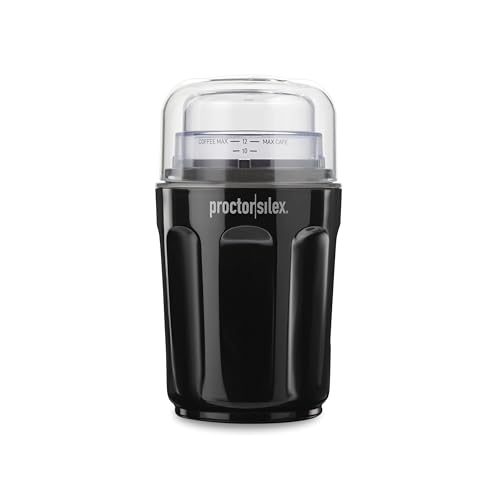
Proctor Silex Sound Shield Electric Coffee Grinder for Quiet Grinding, Stainless Steel Blades, Beans, Spices and More, 12 Cups, Black (80402)
View on Amazon. If your priority is true grind adjustment rather than a blade design, a dedicated burr grinder from a manufacturer that publishes setting charts will serve you better over time.
For more context on choosing among these options, see our guides on how to evaluate a coffee grinder before you buy and how to store coffee beans to keep them fresh. You can also browse our list of the best Proctor Silex coffee grinder models for home brewing to compare this unit with other models in the line.
FAQ
Can the Proctor Silex fresh grind coffee grinder make espresso-fine grounds?
Not reliably. Blade grinders cannot produce the uniform fine particles that espresso requires. You can get a finer result by pulsing longer, but the texture will remain uneven, and espresso extraction is very sensitive to that unevenness.
Is this grinder good for French press coffee?
It can work for French press if you pulse in short bursts and stop to shake the beans, aiming for a coarse, relatively even texture. Expect some fines, and consider pouring slowly to reduce sediment in the cup.
How many cups can it grind at once?
The product name states it is designed for up to 12 cups. In practice, grinding a smaller measured dose gives a more even result than filling the chamber to its limit.
Can I grind spices in the same chamber I use for coffee?
The listing says it is intended for spices, but grinding spices and coffee in the same chamber will transfer flavors between them. Many owners keep a separate chamber or wipe the bowl thoroughly between uses, and some run a small amount of uncooked rice to absorb residual oils.
How do I clean the grinder?
Unplug it first, then remove the chamber and wipe out coffee dust with a dry brush or cloth. Avoid submerging the motor base in water. Oils can accumulate on the blade over time, so periodic cleaning will keep flavors clean.
Does grinding heat the beans?
Blade grinders generate heat through friction, especially during long runs. Pulsing in short bursts limits this effect and helps preserve aroma.
Is this a good first grinder for a beginner?
Yes, as an entry point. It teaches you the value of freshly ground coffee at a low commitment. If you find yourself wanting more control, you can move to a burr grinder later.
Final Verdict
Should you buy the Proctor Silex fresh grind coffee grinder?
Buy it if you want a simple, compact, low-commitment way to grind coffee and spices, and you are comfortable with some variation in particle size. It delivers a usable cup for standard drip and French press brewing when operated with short pulses. Skip it if you brew pour-over, espresso, or any method that depends on precise, repeatable grind size; in those cases, a burr grinder with defined settings is the better investment.
Before you order, compare it with the alternatives above and check current listing details on Amazon.
View on AmazonRelated reading
- 7 Best Proctor Silex Coffee Grinder Models for Home Brewing (2026)
- How to Grind Coffee Without a Grinder
- OXO Coffee Grinder: How to Dial In Grind Size at Home
- Krups Coffee Grinder: How to Get Consistent Grinds at Home
- How Does a Burr Coffee Grinder Work? A Clear Guide to Burrs and Grind Size
- How Can I Grind Coffee Beans Without a Grinder? 7 Best Options (2026)
About Claire Whitaker
Claire Whitaker is part of our editorial team and reviews and edits our coffee gear & accessories guides, checking product details against manufacturer specifications and owner feedback.