By Claire Whitaker
Updated November 2026
A scale to weigh coffee beans lets you measure your dose by mass instead of volume, which is the single easiest way to make your coffee taste the same from one brew to the next. In this guide, you will learn what to look for in a scale, how to weigh your beans and water correctly, how to set a starting ratio, and how to adjust your brew when something tastes off. Once you get the habit, you will stop guessing and start dialing in.
Why weight beats volume for coffee
Scoops are convenient, but they are unreliable. Two scoops of the same coffee can differ noticeably in weight depending on how finely the beans are ground, how tightly they are packed, and how the scoop was filled. Whole beans are less of a problem than ground coffee, but bean density still varies between roasts and origins, and a “level scoop” of a light roast weighs something different from a dark roast with its more open, expanded structure.
Shopping for one? See our guide: 6 Best Digital Scales for Coffee Beans Picks Compared (2026).
Weighing removes that variable. When you measure 18 grams of beans instead of “about a tablespoon,” you give yourself a number you can repeat, record, and adjust. That is the foundation of brew ratio, which is simply the relationship between coffee weight and water weight. Most home brewers start in a range between 1:15 and 1:17 for pour-over and drip, meaning 15 to 17 grams of water for every gram of coffee, though you can move outside that range to suit your taste.
What you need before you start
You do not need a lot of equipment, but a few items make the process smoother:
- A kitchen or coffee scale that reads in grams and has a resolution of 0.1 g. Anything coarser makes small dose changes hard to track.
- A scale with a flat, stable surface and a tare function, so you can zero out the weight of your container.
- A bowl, jar, or brewing vessel large enough to hold your beans or water without spilling when the scale is tared.
- A timer, since brew time is part of the same repeatable process.
- A notebook or phone note to record dose, water weight, grind setting, and taste notes.
How to weigh coffee beans step by step
Step 1: Place the scale on a level surface
Set the scale on a countertop that does not wobble. Uneven surfaces cause readings to drift. Keep the scale away from the edge of the counter so you do not knock it while pouring.
Step 2: Turn it on and let it settle
Power the scale on and wait for the reading to stabilize at zero. Many scales need a few seconds to calibrate, and some will show a fluctuating number if they are picked up or moved.
Step 3: Tare the container
Place your empty bean hopper or bowl on the scale and press tare. The display should return to 0.0 g. This means you are now measuring only what goes into the container.
Step 4: Add the beans
Pour beans into the container until the display reads your target dose. For a single 12-ounce pour-over, many brewers use somewhere between 15 and 20 grams, depending on cup size and taste. Add beans slowly near the target so you do not overshoot.
Step 5: Grind and record
Grind the weighed beans and note the grind setting. Because grind size changes extraction, keeping the setting consistent alongside the dose gives you a complete record.
Step 6: Weigh the water
Tare your brewing vessel, then pour water until the display shows the target weight. Multiply your coffee dose by your chosen ratio. For example, 18 g of coffee at a 1:16 ratio calls for 288 g of water.
Starting ratios and what they do
The table below shows common starting points. These are general guidelines, not rules. Adjust them based on how your coffee tastes.
| Brew method | Typical ratio (coffee : water) | Example for 18 g coffee | Taste tendency when adjusted |
|---|---|---|---|
| Pour-over | 1:15 to 1:17 | 270 to 306 g water | Stronger at lower water weight, lighter at higher |
| Drip machine | 1:15 to 1:17 | 270 to 306 g water | Less control over flow, so ratio matters more for consistency |
| French press | 1:12 to 1:15 | 216 to 270 g water | Heavier body with lower water weight |
| Espresso (dose to yield) | 1:2 to 1:2.5 | 36 to 45 g liquid out | Yield weight matters as much as dose |
Adjusting your brew after you weigh
Once your numbers are consistent, taste becomes the tool for change. Make one adjustment at a time so you know what caused the difference.
- If the cup tastes sour or thin, the extraction may be under-developed. Try a finer grind or a slightly higher dose.
- If the cup tastes bitter, dry, or harsh, the extraction may be over-developed. Try a coarser grind or a lower dose.
- If the cup tastes weak but not sour, lower the water weight slightly rather than changing grind first.
- Record each change with the exact grams so you can repeat a good result later.
Common mistakes to avoid
- Forgetting to tare. This is the most frequent error. A container weighing 100 g will throw off every measurement until you zero it.
- Weighing whole beans and then assuming ground weight is the same. Dose by whole-bean weight before grinding; ground coffee occupies more volume but the mass stays the same, minus small losses to grinder retention.
- Changing several variables at once. Adjust grind, dose, and water one at a time.
- Using a scale with poor resolution. If the display jumps in 1 g steps, small dose changes become guesswork.
- Ignoring temperature drift. Some scales are sensitive to heat or moisture on the platform. Keep it dry and let it stabilize.
- Relying on a single brew. One cup tells you little. Repeat the same recipe two or three times before judging it.
Recommended gear
A basic scale is the core tool, but a few related items make the weighing process easier to repeat.
- A dedicated coffee scale with a built-in timer. Having dose, water, and time in one place keeps your brew log simple. Look for a unit that reads to 0.1 g and has a flat, easy-to-clean surface. View on Amazon
- A small bowl or jar for holding beans. A container that is light and easy to tare keeps your bean weight accurate and prevents spills. View on Amazon
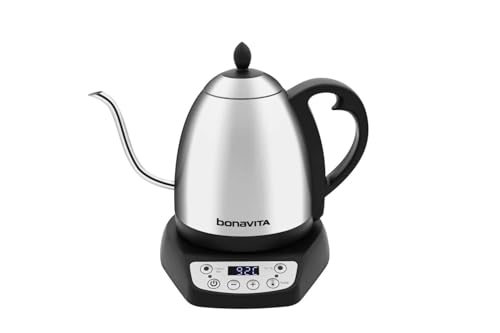
- A gooseneck kettle. Controlled water flow helps you hit your target weight evenly during a pour-over and makes the timing more repeatable. View on Amazon
FAQ
Do I need a special scale to weigh coffee beans?
No, but you do need one that reads in grams with at least 0.1 g resolution and has a tare function. A standard kitchen scale can work if it meets those criteria, though a dedicated coffee scale often includes a timer and a more responsive display.
Should I weigh beans or ground coffee?
Weigh whole beans before grinding for the most accurate dose. Ground coffee loses a small amount of mass to grinder retention, and weighing after grinding can introduce small errors.
How much coffee should I use per cup?
A common starting point is 15 to 18 grams for a single 10 to 12 ounce cup brewed by pour-over, but the right amount depends on your taste, brew method, and the roast you are using.
What ratio is best for pour-over?
Many brewers begin around 1:15 to 1:17. Move toward 1:15 for a stronger cup and toward 1:17 for something lighter, and adjust grind size to balance extraction.
Why does my scale read differently each time?
Common causes include an uneven surface, a scale that has not stabilized, forgetting to tare, or moisture or heat affecting the platform. Recalibrate according to the manufacturer’s instructions if readings stay inconsistent.
Can I use the same scale for espresso?
Yes, and many espresso workflows depend on weighing both dose in and liquid yield out. A scale that responds quickly is helpful for timing shots.
How often should I clean my coffee scale?
Wipe the platform after each brew session to remove grounds, drips, and oils. Check the manufacturer’s care guidance for cleaning recommendations, as some models have sensitive sensors.
Is weighing coffee difficult for beginners?
It takes a few brews to build the habit, but the process is simple: tare, weigh, grind, weigh water, brew, and taste. Keeping a short log of your recipes will help you improve faster.
Conclusion
A scale to weigh coffee beans is one of the most practical upgrades a home brewer can make. Weighing your dose and water gives you repeatable results, a clear ratio to work from, and a reliable way to adjust when a cup is not quite right. Start with a ratio in the 1:15 to 1:17 range, change one variable at a time, and record what you do. Over a few brews, your coffee will become more consistent and easier to control.
Related reading
- Top 5 Bean Scale Coffee Scoop Options for Home Brewers in 2026
- How to Measure Coffee Beans Without a Scale: 3 Reliable Methods
- Digital Coffee Bean Scale Cup: Which Measures Right and Why?
- Coffee Scale for Chemex: How to Weigh Your Brew for Clean Pour-Overs
- Coffee Bean Weighing Scale Picks: 6 Best Options Compared for Home Brewers
- 7 Best Coffee Bean Scale Cup Options for Home Baristas (2026)
Ready to choose one?
About Claire Whitaker
Claire Whitaker is part of our editorial team and reviews and edits our coffee gear & accessories guides, checking product details against manufacturer specifications and owner feedback.