
 By Audrey Hayes
Updated November 2026
The Breville Smart Grinder Pro conical burr grinder is aimed at home brewers who want a programmable, all-in-one grinder without stepping into commercial-grade pricing tiers. It suits people who brew a mix of drip, pour-over, and occasional espresso and want a timed or dose-based grind they can repeat. It is less suited to shoppers who need single-dose precision, very fast grinding for high cup volumes, or a grinder that does nothing but espresso. Buyers who mainly brew coarse French press and never change settings may find simpler, cheaper machines do the job just as well.
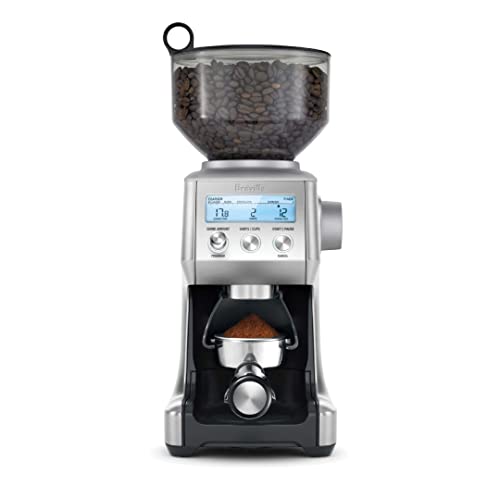
Breville BCG820BSS Smart Grinder Pro for Kitchens, Brushed Stainless Steel | Grind coffee and espresso beans with programmable conical burr coffee grinder including 60 settings for any brew method
Product Overview
The Breville BCG820BSS is the brushed stainless steel version of the Smart Grinder Pro, sold under Breville’s kitchen line. It is a countertop conical burr grinder built around a programmable control panel, a removable bean hopper, and a grind chamber designed to accept both coffee beans and espresso-fine settings. The listing describes it as capable of grinding coffee and espresso beans, with 60 grind settings intended to cover a range of brew methods.
Conical burr grinders use a cone-shaped inner burr that rotates within a matching outer ring. Compared with flat burr designs, conical geometry is commonly described as producing a more gradual grind size distribution and somewhat less heat at the same speed. That is the core reason shoppers look at this category, and it is the design this grinder is built on. For a broader view of the two burr styles, see Flat vs Conical Burr Grinders: What Actually Differs.
In practical terms, the Smart Grinder Pro is positioned as an everyday machine: you load beans, choose a setting or a time-based dose, and let it run. It is not marketed as a single-dose tool or a commercial workhorse, which shapes how you should judge it.
Key Features & Specifications
The table below lists only details that are stated in the product name or are well documented for this model. Where a specification is not clearly established, it is omitted rather than estimated.
| Feature | Details |
|---|---|
| Grinder type | Programmable conical burr grinder |
| Grind settings | 60 settings |
| Intended use | Coffee beans and espresso beans |
| Brew method coverage | Designed for any brew method, per listing |
| Control style | Programmable controls |
| Finish | Brushed stainless steel (BCG820BSS version) |
| Installation | Countertop, freestanding |
Manufacturers typically specify details such as hopper capacity, burr material, and motor output in product documentation. Check the current listing and manual before purchase for exact values, since these can vary by revision.
Pros & Cons
Pros
- A wide range of 60 grind settings gives room to dial in drip, pour-over, and espresso-adjacent grinds on one machine.
- Conical burr geometry is generally associated with more even particles than blade grinders and many entry-level burr designs.
- Programmable operation lets you repeat a dose and grind setting without guessing at timing each morning.
- The brushed stainless finish fits a kitchen counter and is easy to match with other small appliances.
- It covers both coffee and espresso beans, so one grinder can serve more than one brewing habit.
Cons
- Owners commonly report that fine espresso grinds need careful setting tuning, since small adjustments can noticeably change extraction.
- Like most home conical grinders, a retention of ground coffee remains in the chute and burr area, which matters if you switch beans often.
- A countertop footprint and motor noise are typical for this class and may be a concern in small or shared kitchens.
- Grind consistency at the very finest settings is generally considered less forgiving than at medium settings.
- Owners who want single-dose workflow or very fast grinding for large batches may find it limiting.
Performance Analysis
Performance for a grinder like this depends on three things: burr geometry, how evenly it distributes particle sizes, and how well the setting scale maps to real brew results. Conical burrs are widely considered a good fit for home brewing because they tend to produce a more uniform spread of particles than blade grinders, which chop beans unevenly and produce many fines and boulders.
Owner feedback patterns for this model and its sibling versions tend to center on three themes. First, the 60-setting range is often praised for flexibility, with many users finding a comfortable pour-over setting in the middle of the scale and then adjusting from there. Second, espresso-fine work draws the most debate; users who push toward the fine end often report needing several test shots before dialing in a consistent result, which is normal for any grinder asked to do espresso. Third, retention and cleaning come up frequently, since conical grinders hold a small amount of grounds that can carry over between bean changes.
Grind speed and noise are typical for a countertop conical grinder. Expect a noticeable motor sound during each grind. If you grind for multiple cups every morning, the timing and dose controls are the main reasons to choose this model over a manual or entry-level machine. For a fuller comparison of how burr style affects consistency, see Burr Coffee Grinders: Flat vs Conical Burrs, Consistency and Retention.
When troubleshooting uneven results on any conical grinder, the cause is often setting choice, bean freshness, or burr wear rather than the design itself. Why Does My OXO Conical Burr Grinder Produce Uneven Grounds? 6 Causes and Fixes covers the common causes in detail, and many of the same principles apply here.
Who Should Buy This Product?
This grinder fits best if you brew daily at home and want one countertop machine that handles drip, pour-over, and espresso-adjacent grinds with repeatable settings. It is a strong choice for people who value a programmable workflow and are willing to spend a few shots dialing in fine espresso grinds.
You should skip it if you mainly brew coarse French press, use a single cup at a time with a manual method, or need an espresso-only grinder with very tight fine-grind consistency. Shoppers who grind in large commercial volumes or want single-dose freshness should look at dedicated espresso grinders instead.
Buying Guide
Before you commit to any conical burr grinder, decide which brewing methods you use most. If drip and pour-over dominate, you need a clean medium range and reliable repeatability. If espresso is a regular habit, look for finer adjustment steps and a grinder with a proven fine-grind range. Next, consider how much counter space you have, how much noise you can tolerate in the morning, and how often you change beans. Frequent bean changes make retention and cleaning more important.
Setting scale matters more than many shoppers expect. A 60-setting range offers more granularity than a 16- or 20-step dial, but only if the steps are consistent. Read owner reports about how the middle of the range behaves, since that is where most drip and pour-over brewing lives. Finally, check the bean hopper size and whether the grinder has a clear dosing method that suits how you weigh or measure coffee.
If this model does not fit your routine, two well-known alternatives are worth comparing.
- Breville BCG820OLT Smart Grinder Pro (Olive Tapenade): The same core machine in a different finish, useful if you want the Smart Grinder Pro features with a different kitchen look.

Breville BCG820OLT Smart Grinder Pro for Kitchens, Olive Tapenade | Grind coffee and espresso beans with programmable conical burr coffee grinder including 60 settings for any brew method
- Breville BCG820BTR Smart Grinder Pro (Black Truffle): Another colorway of the same programmable conical design, suited to shoppers who prefer a darker countertop finish.

Breville BCG820BTR Smart Grinder Pro for Kitchens, Black Truffle | Grind coffee and espresso beans with programmable conical burr coffee grinder including 60 settings for any brew method
Both alternatives share the same listed feature set, so the choice between them is mainly about finish and personal preference rather than performance. For a wider look at the category, Burr Grinder vs Conical Burr Grinder: Which Should You Choose? explains how to narrow the field.
FAQ
Can the Breville Smart Grinder Pro grind espresso?
Yes. The listing states it can grind both coffee and espresso beans, and it includes settings intended for finer grinds. Expect to take a few test shots to dial in espresso, since fine grinds are more sensitive to small setting changes.
How many grind settings does it have?
The listing specifies 60 grind settings. That range is meant to cover drip, pour-over, and other brew methods, with finer settings toward espresso.
Is it a conical or flat burr grinder?
It is a conical burr grinder, which uses a cone-shaped inner burr inside a matching ring. This design is commonly associated with a more gradual particle distribution than flat burrs at comparable speeds.
Does it have programmable controls?
Yes. The product is described as programmable, which lets you set a repeatable grind and dose rather than timing each batch manually.
Is it loud?
Like most countertop conical grinders, it produces noticeable motor noise while grinding. Owners in shared or small kitchens often plan grind times around morning routines.
Is it suitable for single-dose brewing?
It is not primarily designed as a single-dose grinder. Users who want to grind exactly one dose at a time with minimal retention may prefer a dedicated single-dose model.
How do I clean it?
Manufacturers generally recommend brushing out the grind chamber and chute regularly and removing built-up grounds. Follow the cleaning instructions in the manual, and avoid submerging the motor base.
Final Verdict
Is the Breville Smart Grinder Pro Worth Buying?
For home brewers who want a programmable countertop conical grinder with a wide setting range and the ability to handle both coffee and espresso beans, the Smart Grinder Pro is a sensible, well-rounded choice. Its strengths are flexibility and repeatability. Its limits are the usual ones for this class: fine espresso requires patience, retention needs regular cleaning, and noise is part of the morning routine. If your brewing is mostly drip or pour-over and you value programmable convenience, it is a good match. If you are chasing single-dose espresso or very high volume, look elsewhere.
View on AmazonAbout Audrey Hayes
Audrey Hayes is part of our editorial team and reviews and edits our coffee gear & accessories guides, checking product details against manufacturer specifications and owner feedback.





